The Transmission Line Analyzer runs the full NESC / NERC / IEEE compliance and engineering suite on overhead lines — sag-tension, clearance, thermal rating, EMF, structure loading, vegetation, IEEE 516 live-line work, and blowout — against the same in-process FeatureServer your PLS-CADD structures and conductors land on. Findings are editable features, scenarios are versioned, and compliance evidence exports in one click. No more hopping between PLS-CADD, a separate clearance tool, and a GIS.
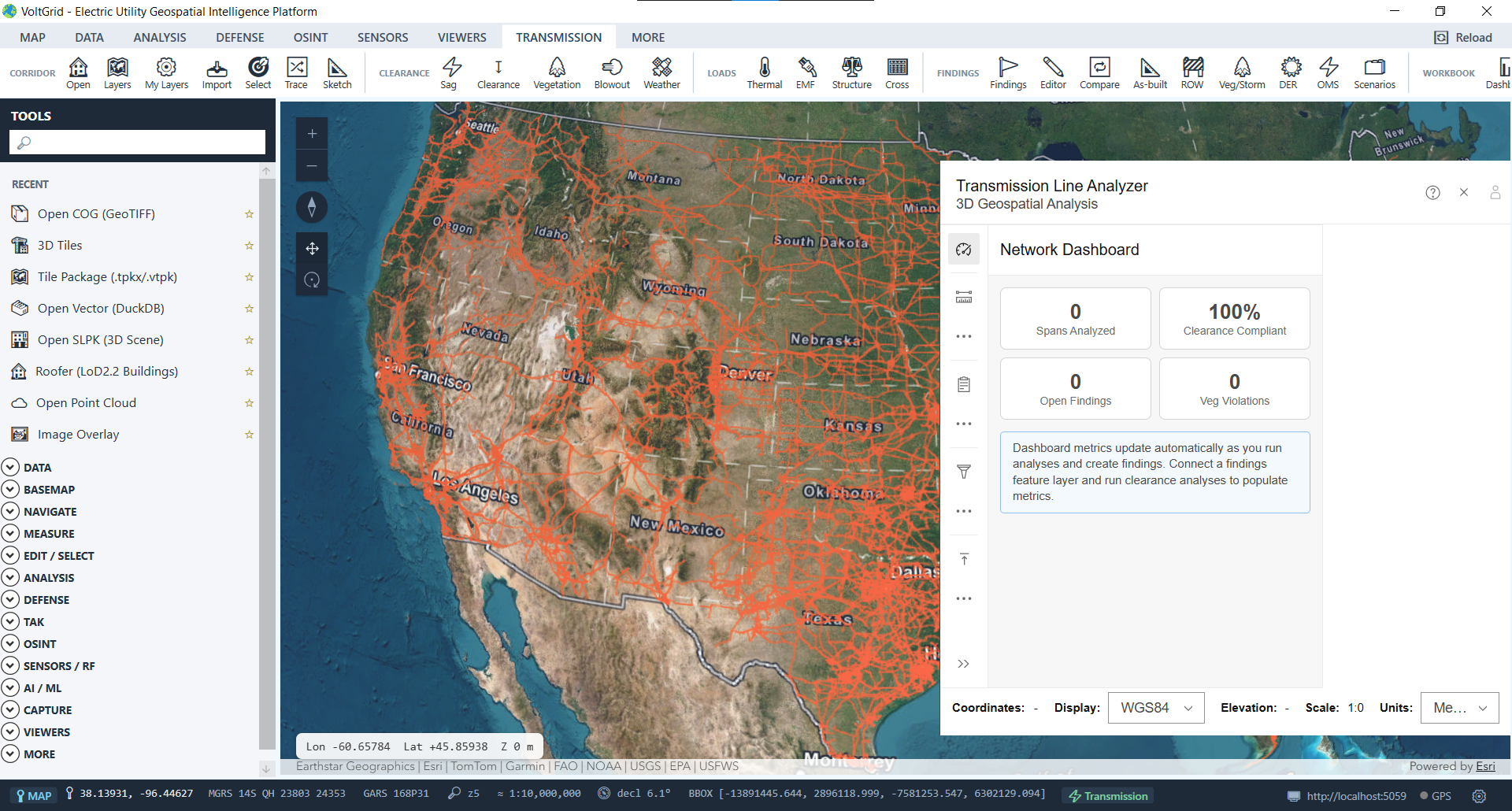
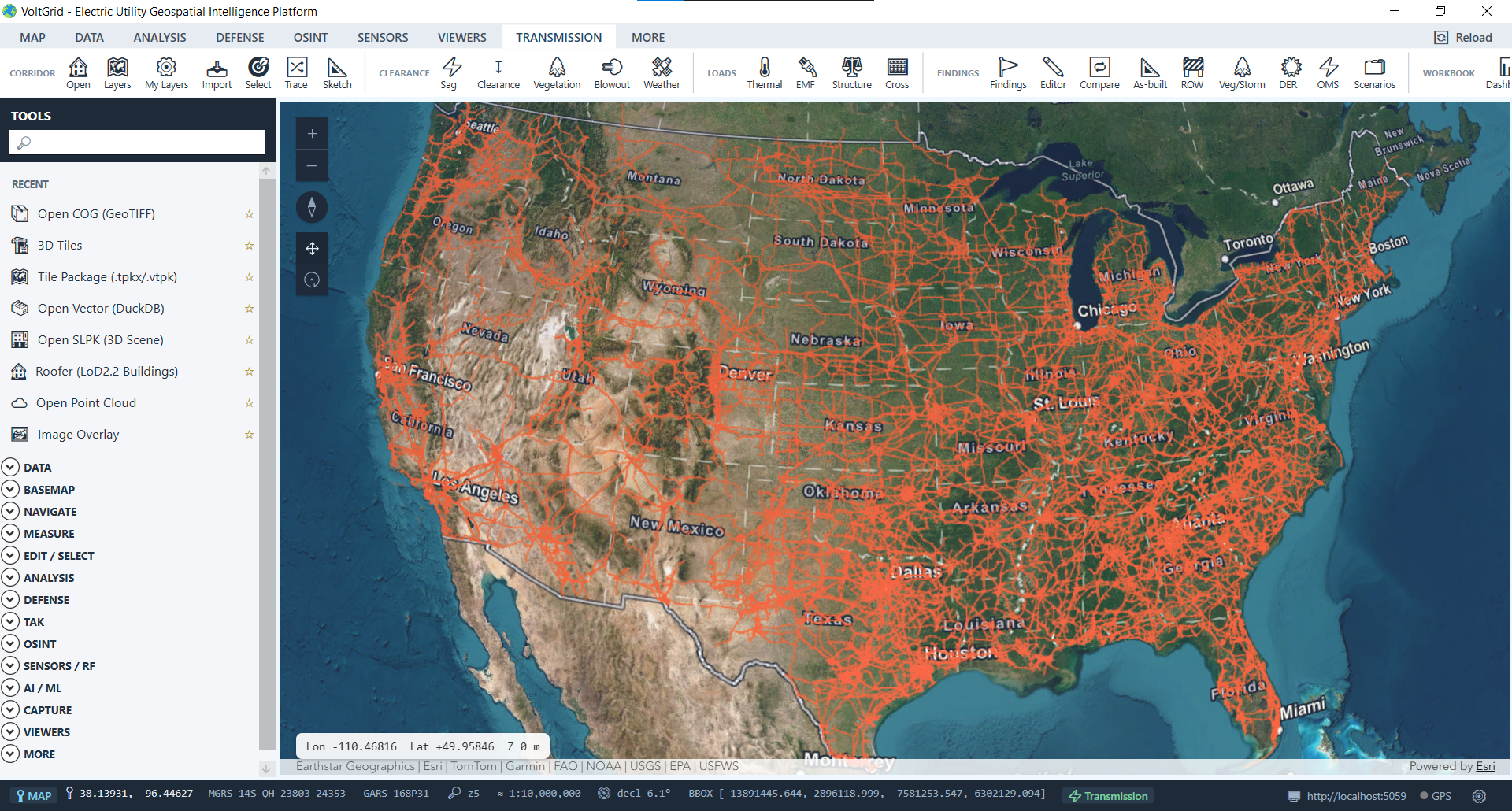
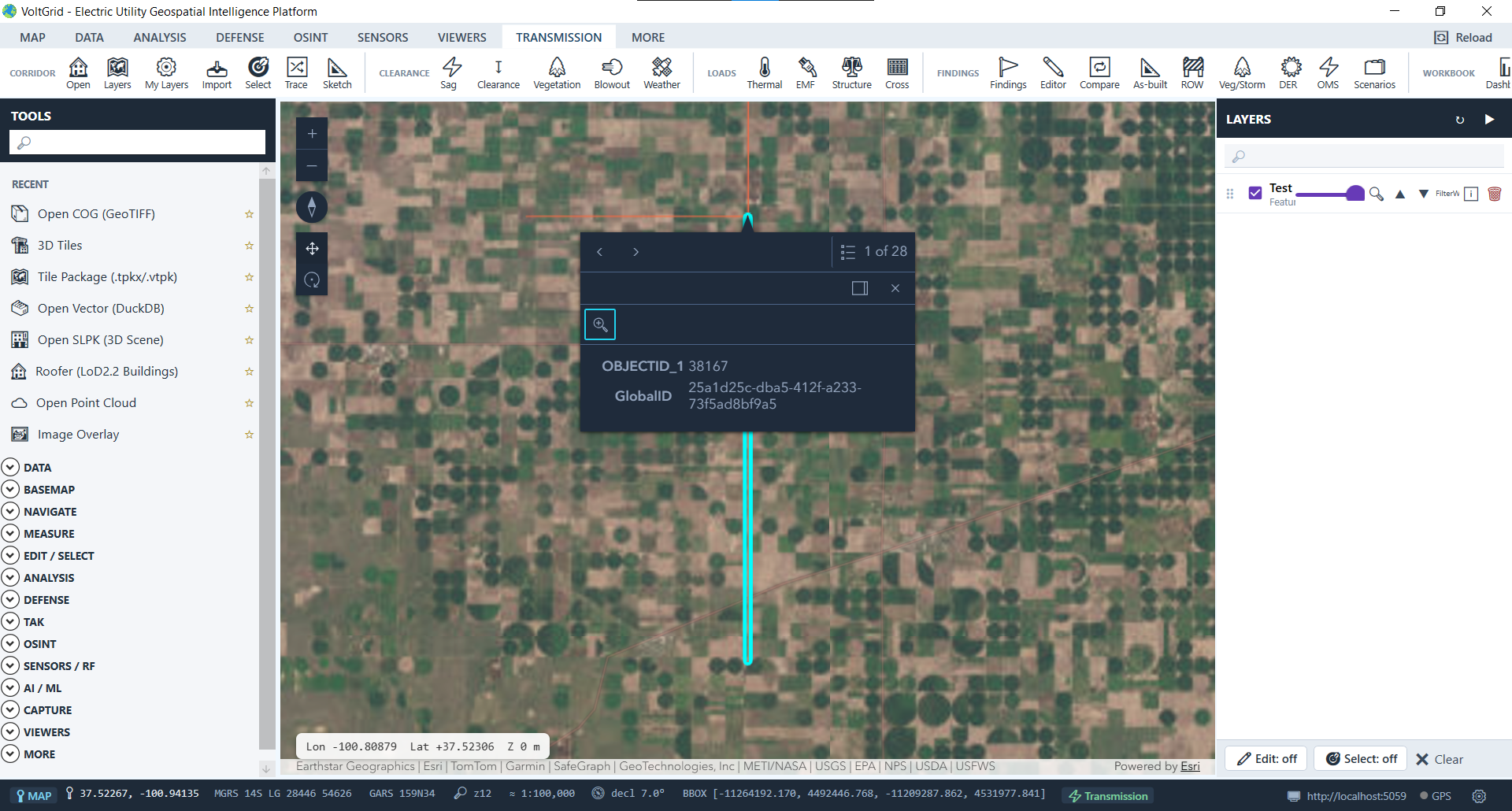
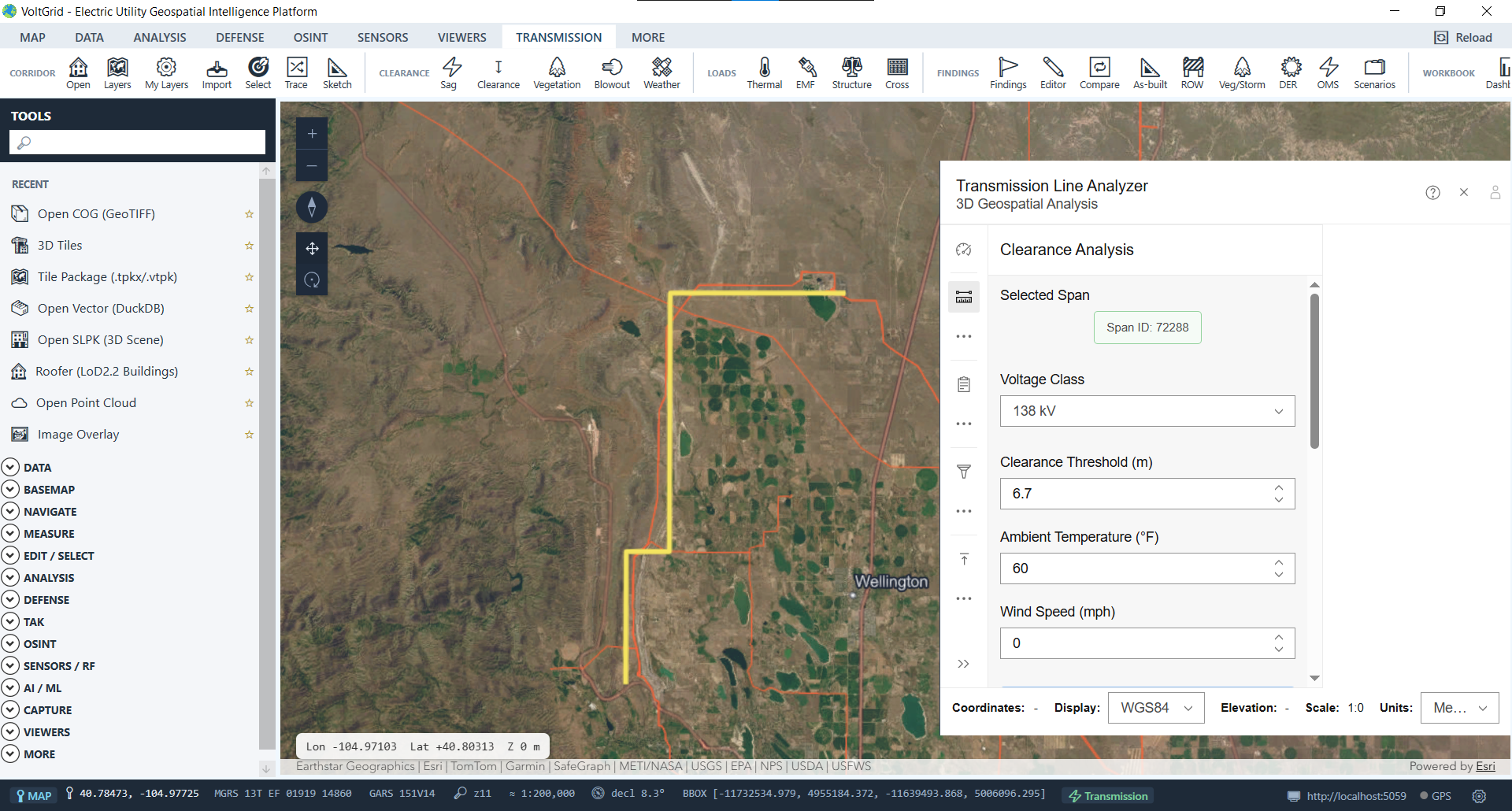
Every analysis shares the same shape: pick a span selection, pick a weather case, click Run. The job lands in the job table with status pending → running → succeeded | failed; results become findings in the findings FeatureLayer at the violation location.
| Analysis | Standard / method | Output |
|---|---|---|
| Sag | Catenary (Roon + Black) | Sag curve overlay + max-sag finding if > NESC limit |
| Clearance | NESC Table 232-1 | Vertical, horizontal, and cross-arm clearance violations |
| Thermal | IEEE 738-2012 | Ampacity rating + thermal limit findings |
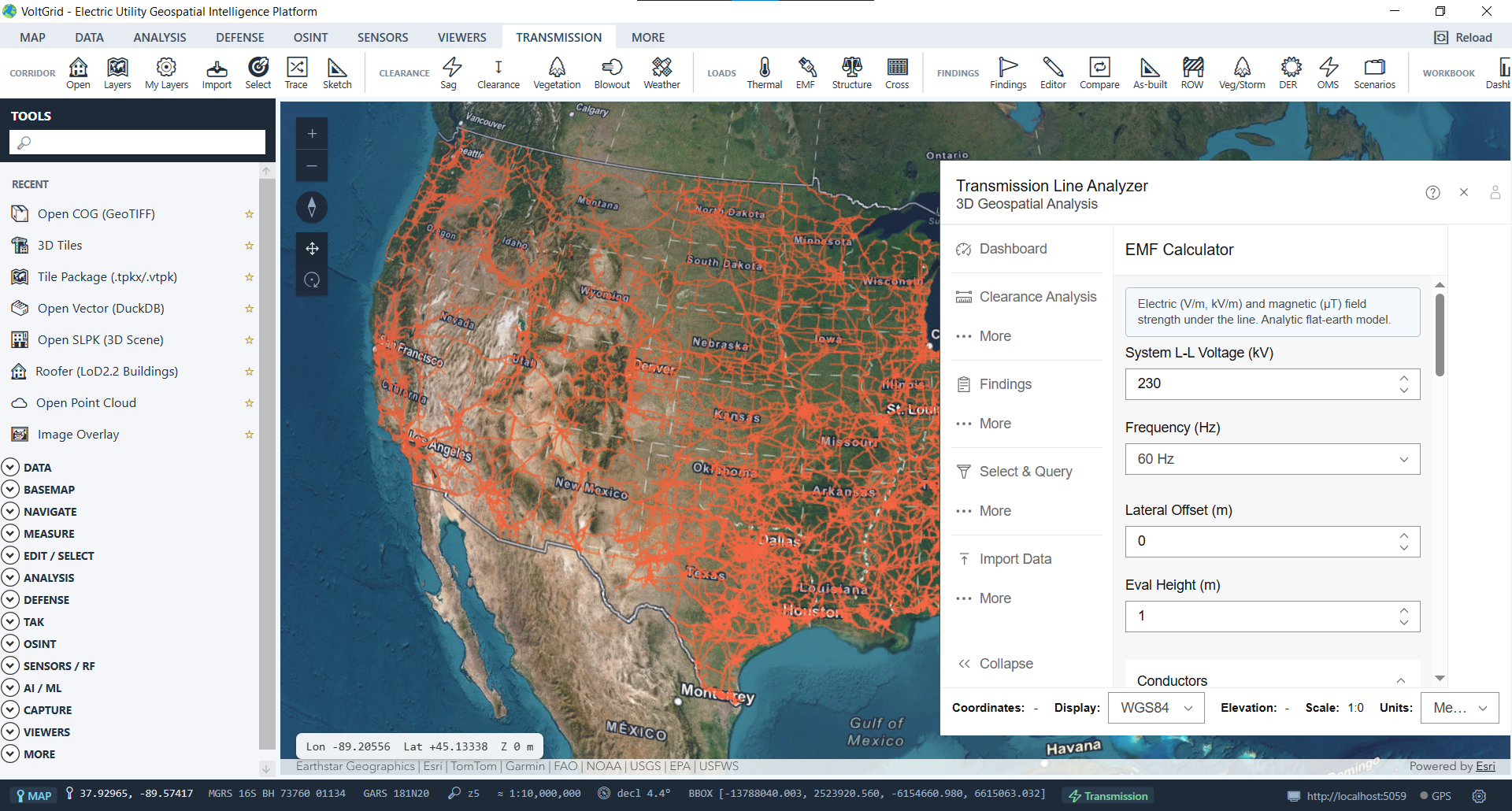
| EMF | Biot-Savart + Maxwell potential coefficients | Phasor-summed B (µT) + E (V/m) contour overlay + threshold findings |
| Structure | NESC Grade B / C loading | Wind + ice + broken-wire overload findings |
| Vegetation | NERC FAC-003 + NESC Table 3 | Grow-in + fall-in vegetation encroachment findings |
| IEEE 516 | IEEE 516 mad-range table | Live-line work minimum approach distance findings |
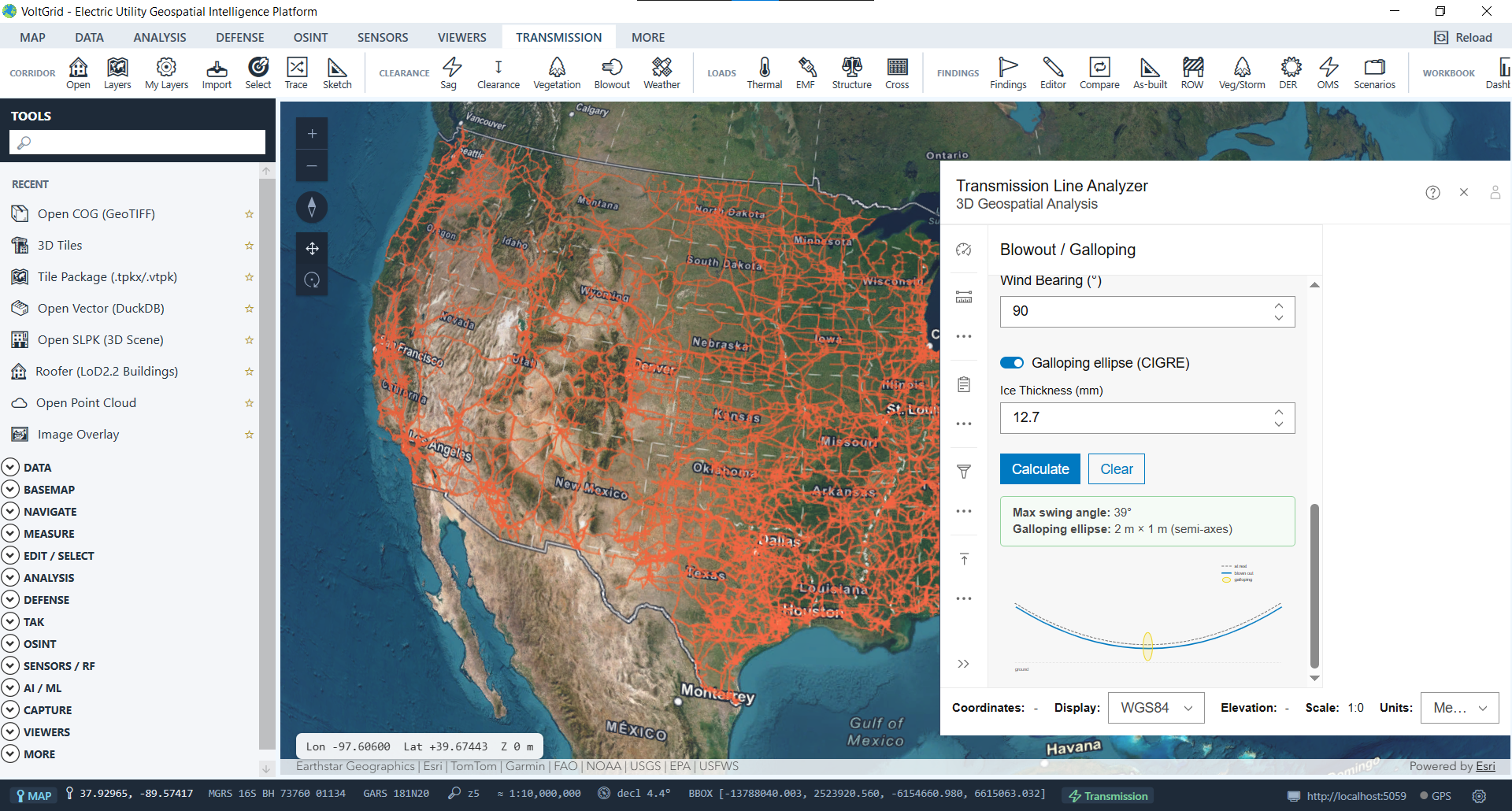
| Blowout | Swing angle + CIGRE galloping ellipse | Mid-span contact + blowout findings |
All engineering calculations execute entirely in-process on the local workstation — no external services or cloud dependencies. Full NESC, NERC, and IEEE standard tables are included.
VoltGrid doesn't reinvent the math. Every transmission engine implements a recognized industry standard — the same formulas your engineers already trust, with the cited clauses baked into the code. Findings carry the standard reference, so audit evidence points at NESC Rule 232-1 or IEEE 516-2021 §5.3, not "VoltGrid's clearance number."
| Standard | Clause / section | What VoltGrid computes | Module / Engine |
|---|---|---|---|
| NESC 2023 Table 232-1 |
Rule 232-1 ground clearances | 24 clearance values — 6 voltage classes (≤0.75 / 0.75–22 / 22–69 / 69–230 / 230–500 / 500+ kV) × 4 crossing types (Road, Pedestrian/driveway, Railroad, Navigable water). Operator overrides flow through scenario payloads. | NESC Clearance Engine |
| NESC Grade B / C Loading |
Grade B & C structure loading (heavy district) | Wind + radial ice + conductor weight → vertical / transverse / resultant load per phase; RBS utilization %; NESC heavy-loading defaults (430 Pa wind, 12.7 mm ice for Grade B). | Structure Loading Engine |
| IEEE 738-2012 Thermal rating |
Steady-state thermal rating | Full heat-balance equation q_c + q_r = q_s + I²R: two forced-convection Nusselt correlations + Grashof natural convection + Stefan-Boltzmann radiative cooling + solar heating; Newton-Raphson conductor-temperature solver; 15-min & 30-min emergency ratings. |
IEEE 738 Thermal Engine |
| IEEE 516-2021 Live-line work |
§5.3 — Minimum Approach Distance | Phase-to-ground MAD lookup across 16 voltage-class rows × 3 work categories (bare-hand / hot-stick / insulated-gloves); exponential altitude correction factor (Table 5) applied above 1000 m. | IEEE 516 Live-Line Engine |
| NERC FAC-003 Vegetation |
Transmission vegetation management | Per-tree Border Zone / Danger Zone / Fall-in categorization against your utility's distance table; priority rollup (critical / high / medium / low) across the corridor; 3D distance + tree-height effective-reach computation. | NERC Vegetation Engine |
| CIGRE Galloping |
Empirical conductor galloping ellipse | Swing angle arctan(F_wind / W) with insulator displacement; ice-amplified galloping ellipse (semi-major 0.3·sag·iceFactor, semi-minor 0.1·sag·iceFactor) for mid-span contact analysis. |
Blowout & Galloping Engine |
| EPRI / IEEE 644 EMF |
Magnetic & electric field measurement methodology | Phasor-summed magnetic field via Biot-Savart (µ₀ · I · √bundleCount / 2π·r); electric field via Maxwell potential-coefficient matrix (Gaussian elimination) with single-image complex-image method; lateral profile sweep. | EMF Calculation Engine |
| Roon & Black Sag-tension |
Catenary / parabolic sag approximation | Mid-span sag w · L² / (8·T) with linear thermal correction; catenary curve sampling; max-sag finding against NESC limit. (Parabolic approximation — valid for sag/span < 10%.) |
Sag-Tension Solver |
| NESC 2023 Plan & Profile |
Plan-profile sheet generation | Composes Sag + Clearance + NescClearanceTable output into a structured Plan/Profile JSON (1:5000 H, 1:500 V, 5× vertical exaggeration) for PDF rendering — engineering scale compliant. | Plan & Profile Generator |
ClearanceTableCache. NERC FAC-003 distances are operator-seeded — they're utility-specific (vegetation growth rates, local growth cycles, MVCD policy), so VoltGrid reads them from your GPKG rather than assuming a national default. Seed once; every subsequent NERC FAC-003 run uses your numbers.
All standard clauses and table values cited above reflect published utility engineering standards. Verify against your jurisdiction's published standard editions before any formal compliance submission.
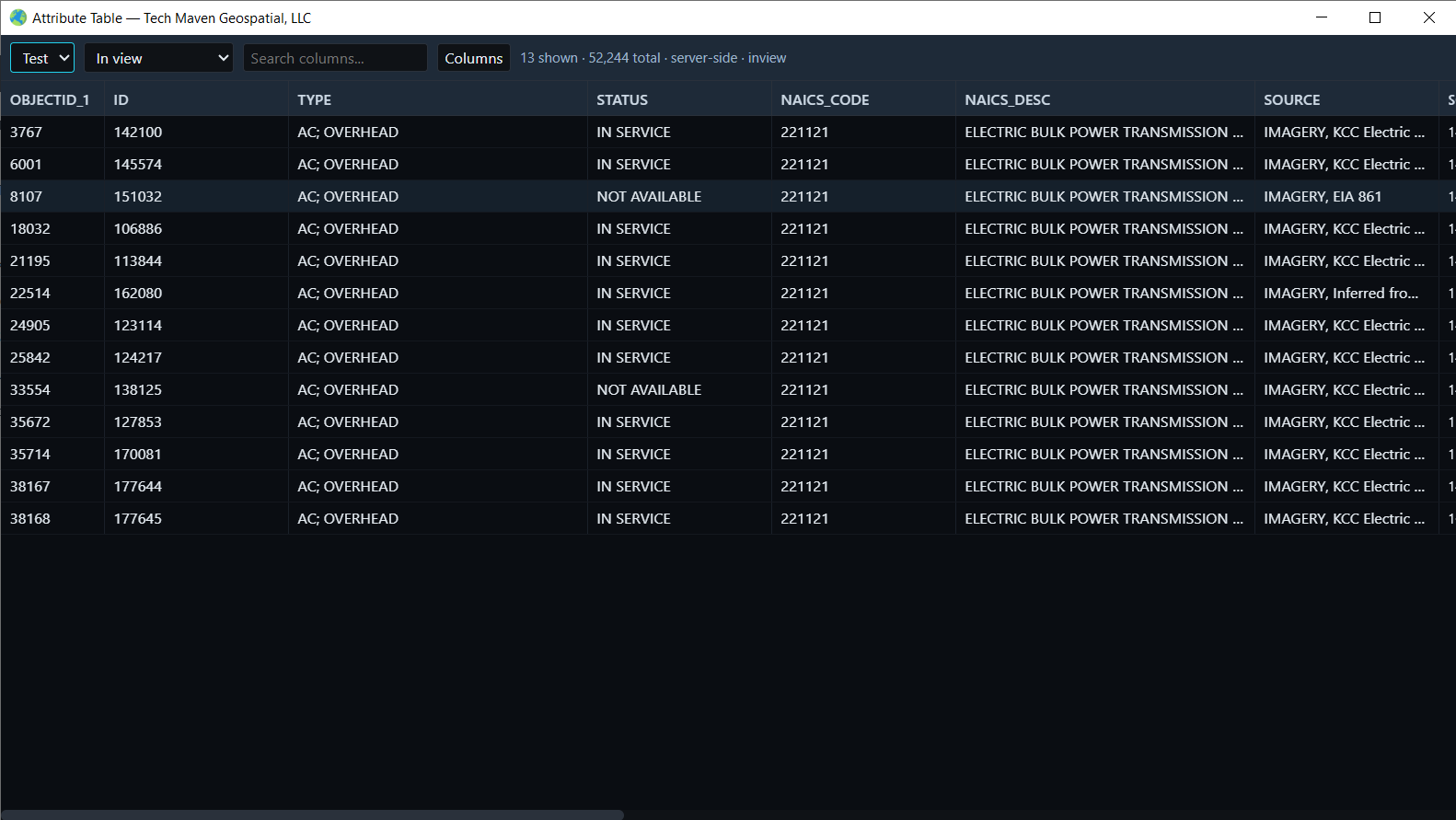
Load structures + conductors from a FeatureLayer, or import PLS-CADD CSV / GeoJSON / Shapefile / FGB / GeoParquet / GPKG directly. Everything lands in the same transmission.gpkg.
Click / box / polygon / named-set selection. Saved selections live in the selection_set table — re-use a span group across every analysis.
Pick weather case (NESC Grade B / C seeded, add your own) + conductor (7 industry conductors seeded: ACSR Drake / Cardinal / Bluebird / Dove / Mallard, AAC Poppy, ACSS Drake). Click Run.
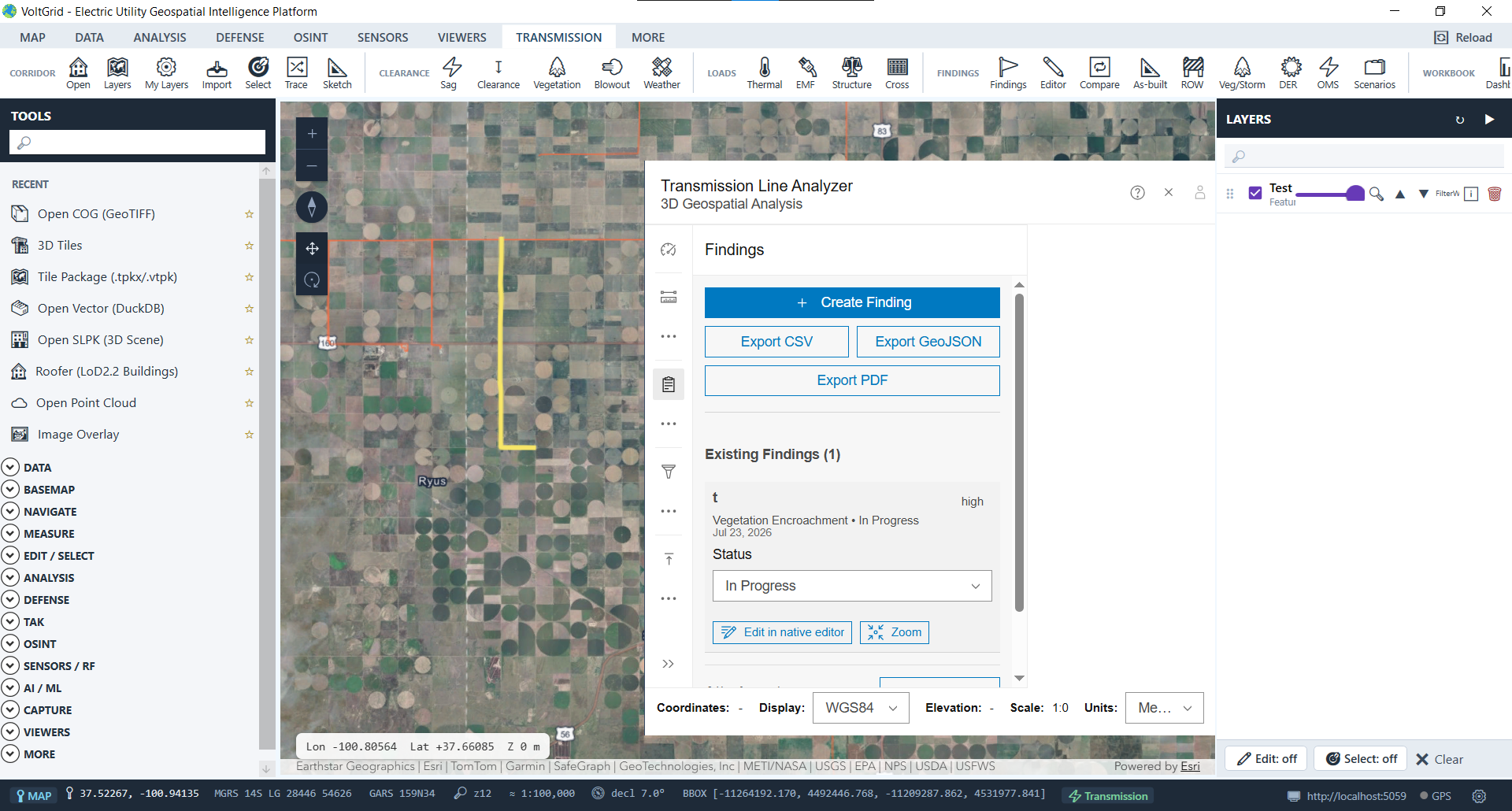
Findings list with filters, status board, and the native Editor widget (create / edit / delete / attach). Promote to work orders or mission tasks directly from a finding.
Scenarios version every analysis run through draft → review → approved → superseded. The KPI dashboard, timeline, compliance view, and report exporter turn a season of corridor work into a single defensible artifact for NERC, state PUC, and internal audit.
Active findings by severity, by analysis type, by span — across the active scenario. Trend the count over time.
Draft → review → approved → superseded. Compare scenarios side-by-side; never lose a prior compliance snapshot.
One-click NERC FAC-003 / NESC / IEEE 516 evidence packs — findings, span list, weather case, conductor, calc method, sign-off.
Elevation resolver walks three tiers: (1) operator-supplied local DEM (LiDAR GeoTIFF), (2) served ImageServer (USGS 3DEP / enterprise DEM), (3) ArcGIS world elevation service. Pick the accuracy you need per run.
Bring your own transmission line FeatureLayer, an additive 3D scene (I3S SceneLayer), and extra feature layers via TRANSMISSION → My Layers. Overrides merge over the bundled config server-side and reload live — no restart, and other tabs' layers are never wiped.
Findings serve through an ArcGIS-canonical FeatureServer facade — consume them from ArcGIS Pro, web maps, or any Esri-REST client, alongside as-built, ROW, and DER findings written by the sibling analyzers.
The same PLS-CADD import now powers feeder trace & isolation preview, as-built vs design, and ROW encroachment — one network model, one findings queue.
Import structures + conductors in one click, then run sag, clearance, vegetation, and live-line clearances against them — no manual GIS re-entry.
